
Rory Stewart’s series on ignorance gets to the heart of what trips us up in organisational change. Here is what research and the scientific method teach us about navigating uncertainty.
I’ve been listening to Rory Stewart’s The Long History of…Ignorance, and it has been reshaping how I think about change, not just organisational change but the way we, as humans, relate to uncertainty more generally and how that in turn affects how we turn up in change. It also took me straight back to my time as a scientist, long before I worked in digital transformation or change management.
When we are young, learning feels like accumulation with a clear path to ‘knowing’. At primary school, knowledge is about facts and right answers - everything seems definitive and all gaps closed and nothing open and flapping. At secondary school, those facts start to connect into systems and still, it feels like we know a lot - we understand the basis of most things. The fundamentals are comfortably conquered. And then, if decide to and have the privilege to enter higher educating, there is a certain pulling aside of the curtain of ‘certain knowledge’ and you realise what you were told we knew definitively, we actually didn’t and entire theories are attempting to explain how the world works. And there are many more black boxes.
And then, if you go on to postgraduate research, as I did, this shifts even more. You move right up to the edge of what your field actually knows, and what becomes most visible at that point is not certainty or mastery, but the vast and sometimes unsettling expanse of what we do not yet understand. Every door that knowledge opens does not lead to neat conclusions; it opens into more rooms full of new questions…and even more doors.
In science, this ignorance is not a sign of failure. It is the frontier.
It is where the interesting work lives, and the deeper you go, the more comfortable you become with the idea that uncertainty is not only inevitable, but necessary and productive. For me, it is actually what got me up in the morning and thrilled me.
This is why the discussions and framings in Rory Stewart’s podcast series resonated so strongly with me. Ignorance is not just a temporary gap that we will eventually close, but a permanent condition of being human in complex systems. No amount of expertise, modelling, or policy design can fully anticipate how reality will unfold. And that, in many ways, is exactly what change feels like inside organisations. And there, right there, is what can trip us up in organisational change.

The Many Faces of Not Knowing
In change and transformation, we are not dealing with a single, simple gap between what we know and what we do not. We are dealing with several different kinds of knowing and not knowing, all operating at the same time.
The Knowns
There are the known knowns: the things we are confident about, based on experience, evidence, or long-established practice.
There are also known unknowns: the questions we are already aware we still need to answer, the risks we have identified, and the areas where we know more discovery work is required.
The Unknowns
Then there are the unknown unknowns: the issues, dependencies, and unintended consequences that only become visible once change is already under way. No matter how thorough the planning, some things simply cannot be anticipated in advance.
And finally, there are what are sometimes called unknown knowns: things that people actually do know, but that have not been surfaced, shared, or connected yet. These might be local workarounds, historical context, cultural norms, or quiet concerns that do not easily find their way into formal reporting.
Uncertainty is not a side effect of poor planning. It is the environment in which change happens.
This is especially true in complex, socially rich organisations like universities, where knowledge is distributed across professional services teams, academics, IT functions, students and their representatives, suppliers, and long institutional memories of “what happened last time”. No steering group, programme dashboard, or business case ever holds all of that context, however well constructed it may be.
So ignorance, or rather the scary emptiness of what we don’t know and what makes us hesitate in change, is rarely about incompetence. More often, it is about fragmentation, assumptions, and the very real limits of perspective.
And here is where the paradox appears. The fact that we do not fully understand the future is what makes change necessary, creative, and full of possibility. Yet that same uncertainty also makes people deeply uncomfortable. Unsurprisingly, we respond by asking for more certainty, more assurance, more evidence: another report, another pilot, another gateway review. Sometimes that is good governance. And sometimes, if we are honest, it is simply a more socially acceptable way of saying that we do not yet feel safe enough to move forward with what we (don’t) know.
Progress Happens, Even If Perfection Doesn’t
None of this is to suggest that change is some endless fog where nothing ever really improves. If we take a longer view, most of us, even the so-called change resistors, would admit we are working in organisations today that are better than they were ten or twenty years ago. Not perfect, and certainly not free of frustration, but better.
We have systems that are more integrated than the paper-heavy processes they replaced. Policies that reflect lessons learned from real harm and real inequities. Greater awareness of accessibility, wellbeing, and student experience. More transparency and accountability than many institutions had in the past. None of that happened by accident. It happened because people were willing to change things without knowing exactly how they would all turn out.
Some of those changes will have, in fact, categorically have, delivered clear net benefit. Others, with hindsight, probably did not land as well as hoped. And that leads to another uncomfortable truth: not all change is good change, but conversely no or dithering on change is rarely a good strategy either.
What concerns me more than change not working perfectly is what happens after we realise that something has not delivered the impact we hoped for. In many organisations, there is very little cultural permission to say, “This did not work as well as we expected. What should we do differently now?” Instead, we often live with sub-optimal outcomes because reversing or adjusting course feels like admitting failure, or because the investment already made makes it politically difficult to change direction.
That is not learning; it is sunk-cost culture.
In science, that would be unthinkable. If an experiment does not produce the expected results, you do not defend the hypothesis more vigorously. You refine it, or you abandon it. That capacity to adapt in the light of evidence is what actually drives progress and helps banish the darkness of ignorance.
What Science Taught Me About Responsible Change
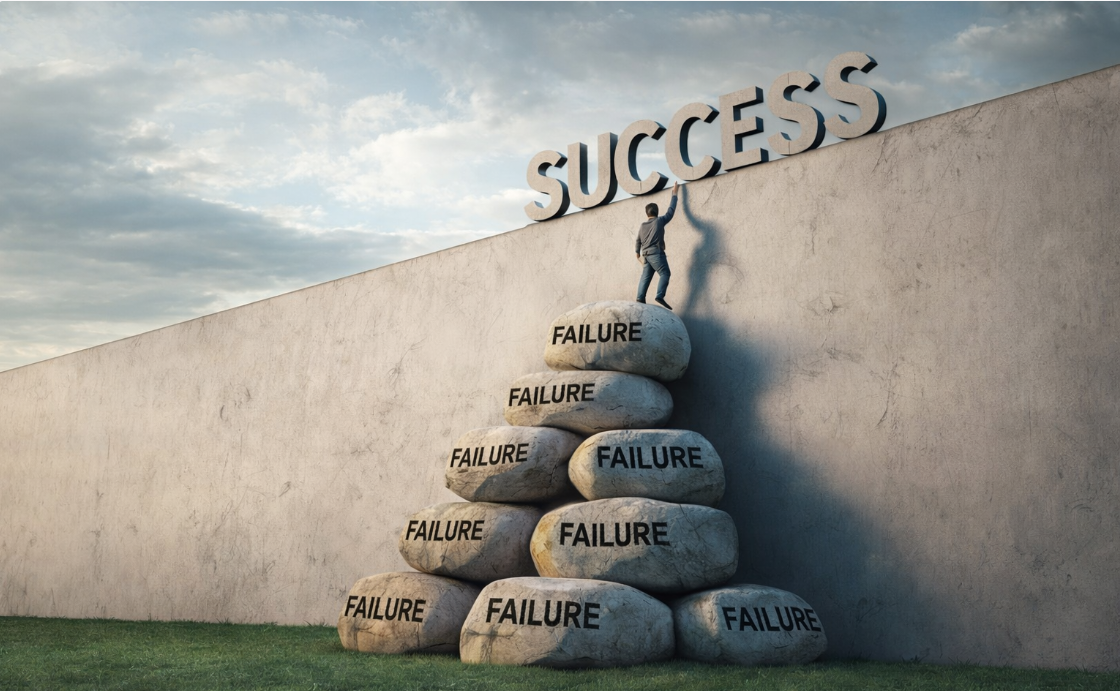
In research, experiments are designed with the expectation that some assumptions will be wrong… that is, you build failure in. That does not mean you plan carelessly… it means you plan with humility. You test hypotheses, observe what actually happens, refine your thinking, and accept that reality always gets a vote.
Failure is not personal. It is information—what you didn’t know before… well, now you do, even if that means what you now know is that you were wrong.
Compare that with how we often treat organisational change. When something does not go to plan, we look for who missed something, who failed to predict, who did not foresee the impact. And while accountability absolutely matters, that mindset can quietly push people towards risk-avoidance and excessive analysis. Into a position of next time, we will tolerate even less ignorance, and demanding that we should know more more more before we consider committing to change.
Humility in change does not mean lowering standards or abandoning rigour.
It means designing programmes that expect learning, rather than pretending uncertainty can be eliminated through documentation alone. It means combining strong governance with strong feedback loops, accountability with psychological safety, and control with curiosity.
Moving Forward Without Pretending We Know Everything
So perhaps the goal of good change leadership is not confidence in all the answers, but confidence in our ability to ask better questions, to notice what we did not expect, and to respond without blame when reality does not match the plan.
Ignorance is not the enemy of change. Unacknowledged and unappreciated ignorance, and fear of admitting that we need to adapt, probably is.
If ignorance is unavoidable, then the real question for our institutions is not how we eliminate it, but whether we are building cultures that can learn without blame when it shows up. Not because that guarantees success, but because it makes progress possible.
History suggests that progress, imperfect and uneven as it is, has always depended on people being willing to move forward before everything was fully known. Change has never been about certainty. It has always been about learning our way into better futures, one imperfect decision at a time.
© Dataqubed Ltd. All rights reserved.