
Everyone is talking about agentic AI—systems that reason, plan, and act. But you can't automate what you don't understand. Here is why many AI dreams will fail, and how to build safe, useful, and grounded AI foundations.
When leaders hear “agentic AI,” their eyes light up. Autonomous reasoning, action, the possibility of offloading entire workflows… it feels like the next frontier. But there’s a fatal assumption baked into the hype: that you can drop an “agent” on top of your infrastructure, connect it to data sources, and watch it take off.
Sorry to break it to you but… in reality, while agentic AI is a powerful accelerant, it is only so if your data foundation is rock solid. Without the right groundwork, it becomes a wrecking ball.

The Readiness Gap: Hype, Confidence, and Hidden Weakness
In a recent Harvard Business Review Pulse survey, nearly two out of three organisations said AI is a strategic priority—but most don’t feel “completely ready” to adopt it. Meanwhile, over half disagreed that their data foundations were ready for the AI era.
The data is clear: many organisations race to adopt generative and agentic AI before they have even sorted out what “good data” means in their own house. It follows logically that organisations with strong data governance and privacy processes are far better positioned when deploying AI, because they can lean on existing controls rather than reinvent everything.
Data quality issues, inconsistency in semantics, organisational data literacy, fluency and contextualised comprehension, not to mention fragmentary system landscapes, are the greatest risks to generative and agentic AI projects—not model complexity. (Harvard’s Is Your Company’s Data Ready for Generative AI? is worth reading on this.)
So if your data is chaotic, ambiguous, or undocumented and your people—as yet still core to delivering service—don’t understand and govern organisational data, then wading in with agentic AI will amplify that chaos. It won’t solve it.
What “Going Agentic” Actually Requires (and Why It’s Non-Negotiable)
First and foremost—Governance and risk frameworks need to be your guiding compass
Agentic systems blur the line between “analysis” and “action.” To control that boundary, you need a rigorous framework for oversight, documentation, and accountability.
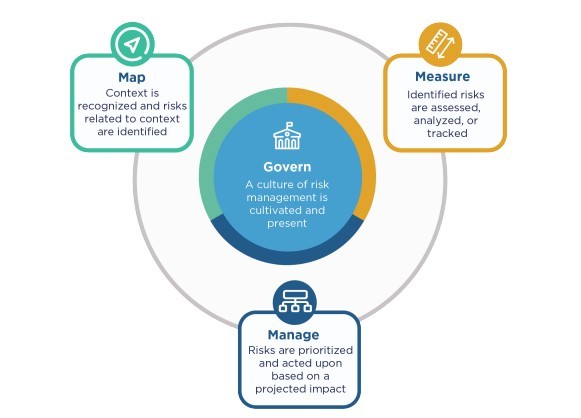
NIST’s AI Risk Management Framework (AI RMF 1.0) is now an industry touchstone. Its core functions—Govern, Map, Measure, Manage—provide a structured, iterative way to monitor AI risk across design, deployment, and runtime.
If you aspire to external audit or compliance, ISO/IEC 42001, the newly minted AI management system standard, offers a certifiable governance structure. In fact, many organisations are combining the NIST framework’s flexibility with the rigor of ISO 42001 to build what’s being called an “AI management system” that’s auditable and iterative.
But frameworks alone won’t save you. You also need real people, roles, and processes: escalation protocols, red-teams, kill switches, audit trails, and clear handoffs between the agent domain and human oversight.
Semantic alignment: making data intelligible across systems
One of the most common failure modes is when two disparate systems use the same term—for instance “Client ID,” “Case Status,” “Risk Score”—but with different meaning. When an agent moves data between these systems, it can inadvertently distort or misinterpret context.
Resolving this requires a knowledge layer: mapping terms, defining ontologies or semantic glossaries, and ensuring consistency in data lineage and meaning across your technology stack. In our experience, the conversations that help enrich this knowledge layer and provide context in data semantics across systems, and then through organisational layers of the data ecosystem and up into the Target Operating Model (TOM) of the organisation, are often missing.

You also need to control master or reference data—a single source of truth—so agents don’t argue with themselves when reconciling fields across multiple tables or systems.
It’s not just a technical burden: it’s a cognitive one.
If the same data element means different things to different teams, you can’t safely trust an autonomous logic layer to reason with it.
Data lifecycle clarity: knowing what flows, when, how, and WHY
Agentic AI depends on contextual inputs—the data it sees must be current, relevant, trustworthy, and traceable. That means you must document:
- What sources feed each system
- When those flows run (real time? batch? triggered?)
- What transformations or filters are applied
- What external vendors or partners receive data
- How long data persists, and what archival rules exist

If you don’t maintain an accurate data inventory, lineage, or interface map, agents will wander into “dark zones” where they make assumptions you no longer control.
Integration and action fabric: safe hooks for agents
An agent that reasons is useless unless it acts. That demands a secure and observable integration layer. You must adopt an approach that gives agents the minimal permissions they need, with enforced scoping, logging, rollback, and auditability—this cannot be stressed enough as we need to build trust especially where agents are making decisions on what may seem like minor process nodes but could have serious onward impact.
Emerging standards like the Model Context Protocol (MCP)—or internal equivalents—are gaining traction to provide a safe “plug-in” for agents without giving them carte blanche over your systems. The industry is watching this space closely, as enterprises demand safer, controlled agent interfaces.
Every call the agent makes—read, write, trigger—needs observability. If something goes wrong, you need forensic traceability, compensating transactions, and human oversight. The worrying thing is that many organisations barely have this in hand currently without the added complexity of the agentic injection.
Human-in-the-loop by design
Autonomy is seductive—but you don’t want agents making every decision. A resilient agentic system requires guardrails: thresholds for autonomous action, escalation logic, rollbacks, audit checkpoints, and human override controls.

The best practitioners build mixed workflows where human judgment remains central for high-risk tasks while agents handle repetitive, bounded actions reliably. Harvard’s implementation guidance underscores that organisations with mature data governance were able to fold AI tools into their existing privacy and risk practices rather than building parallel ones.
Phased use-case strategy (not “agent everything”)
You don’t unleash agents on all processes at once—this is a recipe for disaster. You begin with constrained domains—use cases with clear rules, limited decision boundaries, and low risk of cascading damage (e.g., ticket triage, knowledge routing, scheduled updates). Prove value there, then expand to more complex domains.
Listening to speakers at the latest #ISG AI Summit gave us hope as this is exactly what the early adopters of agentic in large corporates are also cautioning. Think big—start small. Keep it safe by providing sandboxes for experimentation where performance and accuracy can be monitored to build trust and catch compliance gaps.
Continuous evaluation, monitoring, and control
Even after you go live, agentic AI isn’t a “set and forget” exercise. These systems learn, drift, and adapt over time—and so do your data and business processes. What works perfectly on day one may quietly degrade by day ninety.
That’s why continuous testing and evaluation need to be built into the way you run AI, not treated as an afterthought. In practice, that means regularly checking whether the agent is still performing as expected, using the right data, and making decisions within its defined limits.
Researchers have been saying this for years: big, abstract AI “principles” aren’t enough. What actually keeps things safe is turning those principles into practical guardrails—tests, alerts, review loops, and accountability mechanisms.
Recent work in AI governance is helping organisations do just that. Frameworks like the Unified Control Framework bring together the most important compliance and safety checks into one coherent set of controls, while new security models such as MAESTRO help teams think about what could go wrong when multiple agents interact—like conflicting goals, feedback loops, or malicious instructions.
You don’t need to know every acronym. The key takeaway is simple:
Ongoing monitoring isn’t bureaucracy - it’s protection.
A well-run agentic AI programme assumes things will drift, data will change, and the environment will evolve. The organisations that stay safe and compliant are those that keep watching, keep testing, and keep the human oversight switched firmly on.
A Story in Practice
Imagine Organisation ACME Corp, a large financial services firm, excited to deploy an agent to autonomously triage incoming support requests, escalate them, and resolve some automatically. This isn’t beyond where organisational conversations are currently circling as they strive to improve customer experience and reduce the cost of support desks.
This organisation rushes into agent deployment. Within weeks, the agent misrouted high-priority tickets, duplicated work, and escalated internal data inconsistently because different platforms used different “status codes” for “pending” vs. “queued.”
Why did it fail? Because the semantic alignment wasn’t solid—they failed to do the homework and lay the groundwork spoken about earlier in this article. Past that, they lacked audit logs for agent actions, and their rollback strategy was weak.
By contrast, ACME’s competitor, which carefully instrumented data flows, built a knowledge graph, defined clear boundaries, and ran agents in shadow mode first, saw steadily improving throughput and quality.
That’s not hypothetical. In organisations that succeed, the difference isn’t the model. It’s the foundation.
Why This Matters—Especially Now
With AI advancing faster than ever, agents are no longer a speculative future. They are imminent in every enterprise roadmap.
But they are not magic. Read that again.
Without the right foundations, you risk costly errors, amplified bias, compliance breach, or worse—actions you can’t undo. Scaled up, this is a risk none of us want to see turn into real issues, undermining trust in a technology that can truly remove bottlenecks in mission-based services like healthcare and education.
At Dataqubed, we specialize in clearing the fog. We help organisations inventory systems, map data flows, unify semantics, and build governable agent runtimes so AI becomes an accelerator, not a liability.
Because with agentic AI barreling down on all of us, strong foundations aren’t nice-to-haves. They’re the difference between stepping into the future - and tumbling backward into chaos.
👉 Ready to assess your readiness? Contact us for a free 30-minute consultation, no obligation. Let’s see where your blindspots are—and fix them before you go agentic. 📩 hello@dataqubed.com
Ready to build strong data foundations for your organisation? Get in touch with our expert strategy and engineering team today.
References
- NIST. AI Risk Management Framework (AI RMF 1.0). https://www.nist.gov/itl/ai-risk-management-framework
- ISO/IEC 42001. Information technology — Artificial intelligence — Management system. https://www.iso.org/standard/81230.html
- Harvard Business Review. Is Your Company’s Data Ready for Generative AI? https://hbr.org/2024/03/is-your-companys-data-ready-for-generative-ai
- Harvard Business Review. How to Implement AI Responsibly. https://hbr.org/2024/05/how-to-implement-ai-responsibly
- Model Context Protocol. Model Context Protocol (MCP). https://modelcontextprotocol.io/
- Unified Control Framework. The Unified Control Framework (UCF). https://arxiv.org/abs/2503.05937
- Cloud Security Alliance. Agentic AI Threat Modeling Framework: MAESTRO. https://cloudsecurityalliance.org/insights/2025/02/06/agentic-ai-threat-modeling-framework-maestro